TORONTO (Reuters) - Facebook Inc plans to open an artificial-intelligence laboratory in Montreal, which will be run by prominent AI researcher Joelle Pineau, two people familiar with the plan said on Friday.
Tech
Sunday, March 31, 2019
Facebook hires prominent artificial-intelligence expert to open Montreal lab

Facebook hires prominent artificial-intelligence expert to open Montreal lab
TORONTO (Reuters) - Facebook Inc plans to open an artificial-intelligence laboratory in Montreal, which will be run by prominent AI researcher Joelle Pineau, two people familiar with the plan said on Friday.
Tech
National Enquirer: Bezos' girlfriend's brother 'single source' for reports
FILE PHOTO: Jeff Bezos, president and CEO of Amazon and owner of The Washington Post, speaks at the Economic Club of Washington DC"s "Milestone Celebration Dinner" in Washington, U.S., September 13, 2018. REUTERS/Joshua Roberts/File Photo
WASHINGTON (Reuters) - The publisher of the National Enquirer on Sunday said its reports on Amazon Chief Executive Jeff Bezos’ private life were based on information from a single source, the brother of Bezos’ girlfriend, Lauren Sanchez.
The statement from American Media Inc. followed publication by Bezos security chief Gavin De Becker of an article in the Daily Beast in which he said the government of Saudi Arabia had accessed private information from Bezos’ phone.
While De Becker said in the article that there was “high confidence that the Saudis had access to Bezos’ phone,” it was “unclear to what degree, if any, AMI was aware of the details.”
Nevertheless, AMI released a statement saying its reports on Bezos’ affair with Sanchez were based solely on information provided by Michael Sanchez, “who tipped the National Enquirer off to the affair on Sept. 10, 2018, and over the course of four months provided all of the materials for our investigation.
“There was no involvement by any third party whatsoever,” it added.
Gavin de Becker & Associates did not immediately respond to a request for comment. A representative for the Saudi embassy in Washington did not immediately respond to a request for comment.
Reporting by Howard Schneider; additional reporting by Humeyra Pamuk; Editing by Dan Grebler
Our Standards:The Thomson Reuters Trust Principles.
The Only 4 Tools You Need to Improve Your Productivity Today

What I have learned through the process of applying new tools and forming new habits is that eliminating one thing made all the difference between getting bogged down and actually being productive: friction.
Friction is how difficult something is to do. The more friction you have, the harder it is to process and, hence, the more valuable time you take doing it.
For instance, I have tried numerous different apps to help me manage my life. I tried to integrate one tool that had a feature that the others did not, or I would default to tools I knew best, even if they were less effective. It turned out that all the technology advancements meant to help me be more productive actually had the opposite affect -- something I am sure many entrepreneurs have faced.
With that said, I have found a nice balance between a few apps, all of which can fit onto my mobile home screen. Here are tips you can consider if you want to reduce friction and make progress.
Task List
I used to keep running tasks, or actions, in a journal, and while I still find value in journaling regularly, I have transitioned to a mobile and web-based task tracker called Todoist. I personally like this app because it allows me to easily create, categorize, prioritize and assign important tasks. Moreover, I can use Siri to quickly add tasks on the go, and I can save tasks by emailing them to the app or quickly saving them from my mobile device.
The free version is limited, and I personally find that premium services and benefits are worth $3 per month.
Whatever task list you use, just make sure that you can easily create and prioritize tasks, so you can quickly put it into your list and stay focused on the task you were doing.
Note Keeper
I am always thinking of ideas or coming across information I want to read and digest later when I have time. A task list is useful in this regard, but I use Evernote to quickly save and tag this information so that I can return to it later.
While Evernote does have a premium cost, I have been using the free version for years now with no issues. If you plan on using Evernote on an enterprise level or with others on a team, it is worth considering the premium service.
Calendar
No busy entrepreneur or manager can survive without a calendar. For the most part, most calendars sync together, between Google, iOS, Miscrosoft365 and any number of other calendars you may use, so choose something you feel comfortable with.
One app I have found very useful is Calendly.com, which syncs to whatever calendar you use and allows you to create a custom URL you can share with others. After setting it up, you can send the URL to anyone looking to set an appointment without the back-and-forth of email or voice mails trying to find a time that works for everyone.
The free version of Calendly is limited, and the premium will run $8 per month. Only you can weigh the value in that, but I have certainly appreciated the ease by which setting appoints has become.
Cloud Storage
Lastly, we all need a "file cabinet" to keep documents and file away important things. The safest place these days (so long as you set up the right protection, starting with your password) is to keep your files in the cloud using a service like Dropbox, OneDrive or Google Drive. Like calendars, all of these services are easy to use, have web and mobile based interfaces for easy management, and all start with an adequate amount of free storage (unless you are storing videos or other data-heavy files).
The advice I give, and what has worked well with me so far, is to spend a little time with your cloud storage and organize as if you would a physical file cabinet. The nice thing is that with cloud storage, you can easily change and move files around, unlike when you create actual file folders for your desk.
To reduce friction, have your cloud storage set up with an "Inbox" folder, where you will save all files to file later. Again, this helps reduce immediate friction to free you up for more important tasks.
Lastly, I also advise to have a good scanning app -- Evernote and many cloud storage apps have a scanning feature -- and keep all your files electronically. This may not sit well with some readers, and I get it, and in the end you need to do what is most comfortable for you.
With these four things, I have managed to reduce the number of steps and actions needed to save a piece of information, create a task for later or set an appointment. Every week, I go through all apps and organize everything, process it, or get rid of it. All of these features work well together, but ultimately, you should find the apps or service that you like best.
What do you think? What other apps and services do you use to help you make daily progress toward your goals? Please share your thoughts with me on Twitter.
The Only 4 Tools You Need to Improve Your Productivity Today
What I have learned through the process of applying new tools and forming new habits is that eliminating one thing made all the difference between getting bogged down and actually being productive: friction.
Friction is how difficult something is to do. The more friction you have, the harder it is to process and, hence, the more valuable time you take doing it.
For instance, I have tried numerous different apps to help me manage my life. I tried to integrate one tool that had a feature that the others did not, or I would default to tools I knew best, even if they were less effective. It turned out that all the technology advancements meant to help me be more productive actually had the opposite affect -- something I am sure many entrepreneurs have faced.
With that said, I have found a nice balance between a few apps, all of which can fit onto my mobile home screen. Here are tips you can consider if you want to reduce friction and make progress.
Task List
I used to keep running tasks, or actions, in a journal, and while I still find value in journaling regularly, I have transitioned to a mobile and web-based task tracker called Todoist. I personally like this app because it allows me to easily create, categorize, prioritize and assign important tasks. Moreover, I can use Siri to quickly add tasks on the go, and I can save tasks by emailing them to the app or quickly saving them from my mobile device.
The free version is limited, and I personally find that premium services and benefits are worth $3 per month.
Whatever task list you use, just make sure that you can easily create and prioritize tasks, so you can quickly put it into your list and stay focused on the task you were doing.
Note Keeper
I am always thinking of ideas or coming across information I want to read and digest later when I have time. A task list is useful in this regard, but I use Evernote to quickly save and tag this information so that I can return to it later.
While Evernote does have a premium cost, I have been using the free version for years now with no issues. If you plan on using Evernote on an enterprise level or with others on a team, it is worth considering the premium service.
Calendar
No busy entrepreneur or manager can survive without a calendar. For the most part, most calendars sync together, between Google, iOS, Miscrosoft365 and any number of other calendars you may use, so choose something you feel comfortable with.
One app I have found very useful is Calendly.com, which syncs to whatever calendar you use and allows you to create a custom URL you can share with others. After setting it up, you can send the URL to anyone looking to set an appointment without the back-and-forth of email or voice mails trying to find a time that works for everyone.
The free version of Calendly is limited, and the premium will run $8 per month. Only you can weigh the value in that, but I have certainly appreciated the ease by which setting appoints has become.
Cloud Storage
Lastly, we all need a "file cabinet" to keep documents and file away important things. The safest place these days (so long as you set up the right protection, starting with your password) is to keep your files in the cloud using a service like Dropbox, OneDrive or Google Drive. Like calendars, all of these services are easy to use, have web and mobile based interfaces for easy management, and all start with an adequate amount of free storage (unless you are storing videos or other data-heavy files).
The advice I give, and what has worked well with me so far, is to spend a little time with your cloud storage and organize as if you would a physical file cabinet. The nice thing is that with cloud storage, you can easily change and move files around, unlike when you create actual file folders for your desk.
To reduce friction, have your cloud storage set up with an "Inbox" folder, where you will save all files to file later. Again, this helps reduce immediate friction to free you up for more important tasks.
Lastly, I also advise to have a good scanning app -- Evernote and many cloud storage apps have a scanning feature -- and keep all your files electronically. This may not sit well with some readers, and I get it, and in the end you need to do what is most comfortable for you.
With these four things, I have managed to reduce the number of steps and actions needed to save a piece of information, create a task for later or set an appointment. Every week, I go through all apps and organize everything, process it, or get rid of it. All of these features work well together, but ultimately, you should find the apps or service that you like best.
What do you think? What other apps and services do you use to help you make daily progress toward your goals? Please share your thoughts with me on Twitter.
National Enquirer: Bezos' girlfriend's brother 'single source' for reports
FILE PHOTO: Jeff Bezos, president and CEO of Amazon and owner of The Washington Post, speaks at the Economic Club of Washington DC"s "Milestone Celebration Dinner" in Washington, U.S., September 13, 2018. REUTERS/Joshua Roberts/File Photo
WASHINGTON (Reuters) - The publisher of the National Enquirer on Sunday said its reports on Amazon Chief Executive Jeff Bezos’ private life were based on information from a single source, the brother of Bezos’ girlfriend, Lauren Sanchez.
The statement from American Media Inc. followed publication by Bezos security chief Gavin De Becker of an article in the Daily Beast in which he said the government of Saudi Arabia had accessed private information from Bezos’ phone.
While De Becker said in the article that there was “high confidence that the Saudis had access to Bezos’ phone,” it was “unclear to what degree, if any, AMI was aware of the details.”
Nevertheless, AMI released a statement saying its reports on Bezos’ affair with Sanchez were based solely on information provided by Michael Sanchez, “who tipped the National Enquirer off to the affair on Sept. 10, 2018, and over the course of four months provided all of the materials for our investigation.
“There was no involvement by any third party whatsoever,” it added.
Gavin de Becker & Associates did not immediately respond to a request for comment. A representative for the Saudi embassy in Washington did not immediately respond to a request for comment.
Reporting by Howard Schneider; additional reporting by Humeyra Pamuk; Editing by Dan Grebler
Our Standards:The Thomson Reuters Trust Principles.
National Enquirer: Bezos' girlfriend's brother 'single source' for reports
FILE PHOTO: Jeff Bezos, president and CEO of Amazon and owner of The Washington Post, speaks at the Economic Club of Washington DC"s "Milestone Celebration Dinner" in Washington, U.S., September 13, 2018. REUTERS/Joshua Roberts/File Photo
WASHINGTON (Reuters) - The publisher of the National Enquirer on Sunday said its reports on Amazon Chief Executive Jeff Bezos’ private life were based on information from a single source, the brother of Bezos’ girlfriend, Lauren Sanchez.
The statement from American Media Inc. followed publication by Bezos security chief Gavin De Becker of an article in the Daily Beast in which he said the government of Saudi Arabia had accessed private information from Bezos’ phone.
While De Becker said in the article that there was “high confidence that the Saudis had access to Bezos’ phone,” it was “unclear to what degree, if any, AMI was aware of the details.”
Nevertheless, AMI released a statement saying its reports on Bezos’ affair with Sanchez were based solely on information provided by Michael Sanchez, “who tipped the National Enquirer off to the affair on Sept. 10, 2018, and over the course of four months provided all of the materials for our investigation.
“There was no involvement by any third party whatsoever,” it added.
Gavin de Becker & Associates did not immediately respond to a request for comment. A representative for the Saudi embassy in Washington did not immediately respond to a request for comment.
Reporting by Howard Schneider; additional reporting by Humeyra Pamuk; Editing by Dan Grebler
Our Standards:The Thomson Reuters Trust Principles.
National Enquirer: Bezos' girlfriend's brother 'single source' for reports
FILE PHOTO: Jeff Bezos, president and CEO of Amazon and owner of The Washington Post, speaks at the Economic Club of Washington DC"s "Milestone Celebration Dinner" in Washington, U.S., September 13, 2018. REUTERS/Joshua Roberts/File Photo
WASHINGTON (Reuters) - The publisher of the National Enquirer on Sunday said its reports on Amazon Chief Executive Jeff Bezos’ private life were based on information from a single source, the brother of Bezos’ girlfriend, Lauren Sanchez.
The statement from American Media Inc. followed publication by Bezos security chief Gavin De Becker of an article in the Daily Beast in which he said the government of Saudi Arabia had accessed private information from Bezos’ phone.
While De Becker said in the article that there was “high confidence that the Saudis had access to Bezos’ phone,” it was “unclear to what degree, if any, AMI was aware of the details.”
Nevertheless, AMI released a statement saying its reports on Bezos’ affair with Sanchez were based solely on information provided by Michael Sanchez, “who tipped the National Enquirer off to the affair on Sept. 10, 2018, and over the course of four months provided all of the materials for our investigation.
“There was no involvement by any third party whatsoever,” it added.
Gavin de Becker & Associates did not immediately respond to a request for comment. A representative for the Saudi embassy in Washington did not immediately respond to a request for comment.
Reporting by Howard Schneider; additional reporting by Humeyra Pamuk; Editing by Dan Grebler
Our Standards:The Thomson Reuters Trust Principles.
Stanphyl Capital Letter - March 2019
March 29, 2019
Friends and Fellow Investors:
For March 2019, the fund was up approximately 5.5% net of all fees and expenses. By way of comparison, the S&P 500 was up approximately 1.9% while the Russell 2000 was down approximately 2.1%. Year-to-date 2019 the fund is up approximately 12.8% while the S&P 500 is up approximately 13.6% and the Russell 2000 is up approximately 14.6%. Since inception on June 1, 2011, the fund is up approximately 85.4% net while the S&P 500 is up approximately 148.5% and the Russell 2000 is up approximately 102.4%. Since inception the fund has compounded at approximately 8.2% net annually vs. 12.3% for the S&P 500 and 9.4% for the Russell 2000. (The S&P and Russell performances are based on their "Total Returns" indices which include reinvested dividends.) As always, investors will receive the fund"s exact performance figures from its outside administrator within a week or two. (If you"re an investor in the fund, you should have your 2018 K-1 next week.)
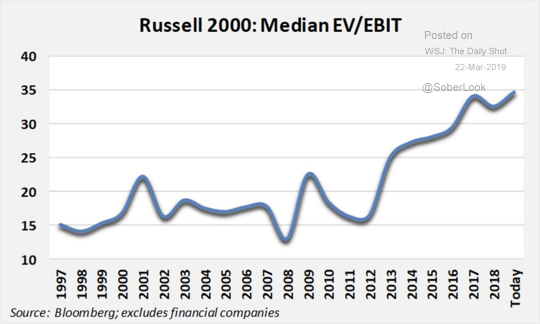
I continue to believe that what we"ve seen since the market"s late December low is a bear market rally, albeit a fierce one. The U.S. economic slowdown is in its early stages and we"re a long way from QE4; in fact, the Fed is still removing approximately $50 billion a month from its balance sheet and - despite the taper announced in March - will continue removing tens of billions of dollars a month through September, while real short-term U.S. interest rates are positive for the first time in over a decade. We thus remain short the Russell 2000 (NYSEARCA:IWM), an index which-despite incorporating almost a full year of drastically lower corporate tax rates-has a trailing twelve-month GAAP PE ratio of around 43 (and I strongly suspect the "E" will go down this year) and a record-high percentage of its constituent companies losing money…
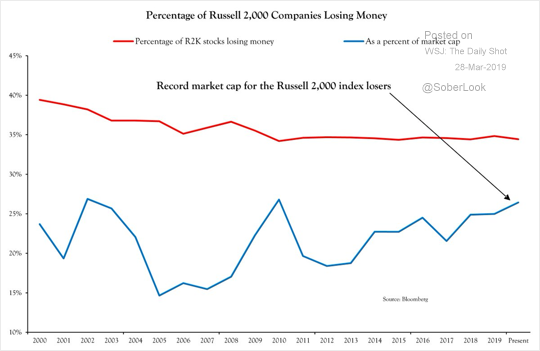
…along with a median EV-to-EBIT that"s (almost literally!) off the charts:
Elsewhere in the fund"s short positions…
We remain short stock and call options in Tesla, Inc. (NASDAQ:TSLA), which I consider to be the biggest single stock bubble in this whole bubble market. The core points of our Tesla short position are:
- Tesla has no electric vehicle "moat" of any kind; i.e., nothing meaningfully proprietary in terms of design or technology, while existing automakers-unlike Tesla-have a decades-long "experience moat" of knowing how to mass-produce, distribute and service high-quality cars consistently and profitably.
- Tesla is now a "busted growth story"; demand for its existing models has peaked and it will have to raise billions of dollars to produce new ones.
- Tesla is again losing a lot of money with a terrible balance sheet while suddenly confronting massive competition in every aspect of its business
- Elon Musk is extremely untrustworthy.
In mid-March, seemingly in response to its sliding stock price (which may have been approaching Elon Musk"s margin call territory), Tesla rushed out an ill-prepared Model Y unveiling on extremely short notice, inspiring its chief engineer to immediately quit. Supposed to be a small electric SUV/crossover, the event showed only a fake clay model and a bodywork-disguised Model 3, and was a complete embarrassment beautifully summarized here by Zero Hedge. By the time the Model Y is available in late 2020/early 2021 (if Tesla is still in business then), it will face superior competition from the much nicer Audi Q4 e-tron, BMW iX3, and Mercedes EQC.
Tesla"s backlog is now gone and new orders severely lag, and in response this month it finally introduced a $35,000 version of the Model 3. Despite the fact that this car has just 220 miles of range and comes only in black with a cheap cloth interior, I estimate it will have an EBIT loss of at least $3000 before options, which is undoubtedly why Tesla is delaying its arrival despite taking deposits for it. Tesla also introduced a 240-mile version for $37,500; that one may "only" lose around $1500 but is less likely to be "optioned up," as it has power seats and a nicer interior (although the only standard color remains black).
Also keep in mind that since January Tesla has slashed thousands of dollars from the prices of all its other cars - longer-range Model 3s as well as the S and X, so throughout 2019 (vs. the peak quarters of Q3 & Q4 2018) Tesla will experience a deadly combination of declining volume and declining ASPs. In January, the company reported a Q4 2018 GAAP profit of $139 million that was considerably smaller than Q3"s never-to-be-topped and highly misleading (as explained in previous letters) figure of $312 million, and now as ASPs and volume decline while under-reserved warranty expenses soar, Tesla shall slide back into losses that I estimate on a GAAP basis will be well over $1 billion for 2019. That said…
In yet another example of typical Tesla "wise-guy scamminess," the Q1 2019 GAAP loss may not be anywhere near as bad as it should be, as there"s a real chance that Tesla may use its sudden redefinition of "Full Self-Driving" (which, according to Tesla but NOT the customers who paid for that feature, now means nothing of the sort) in order to recognize hundreds of millions of dollars of deferred revenue to which it"s nowhere *near* entitled. See this excellent Twitter thread.
What else did this alleged "growth company" do in March? Well, after initially announcing (in a spur-of-the-moment cost-saving measure) that it was closing 90% of its retail stores, Tesla soon backtracked and decided to close "only" around half of them, most likely when someone informed Musk - who is truly a business moron - that the company was on the hook for all those leases anyway.
In late February, the SEC finally lost patience with Elon Musk"s continual violation of last year"s settlement stemming from his fraudulent "$420 buyout" tweet and asked the presiding judge to hold him in contempt, to which Musk (of course) swiftly responded by further mocking the SEC. Written arguments were presented by both sides in March and the presiding judge will hold a hearing on April 4th. Despite the terrible precedent Musk"s behavior sets for the CEOs of any other public company, I don"t have much faith that justice will be served here by either the court or Tesla"s fully complicit board; of course the latter"s source of complicity is clear: this is the most grotesquely overpaid group of corporate whores I"ve ever seen on the board of any public company…
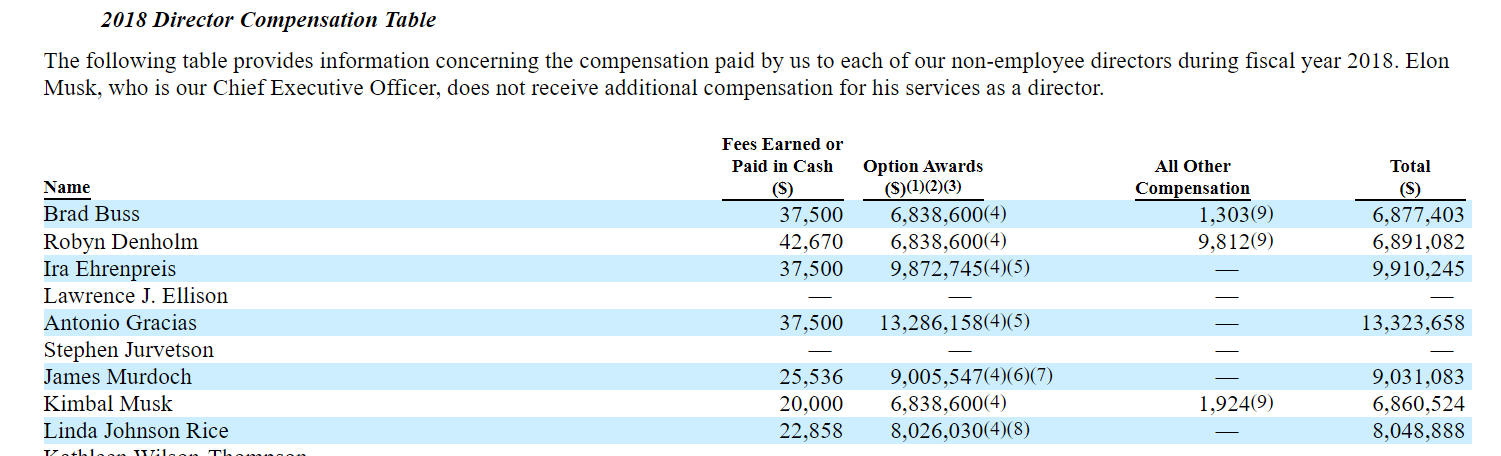
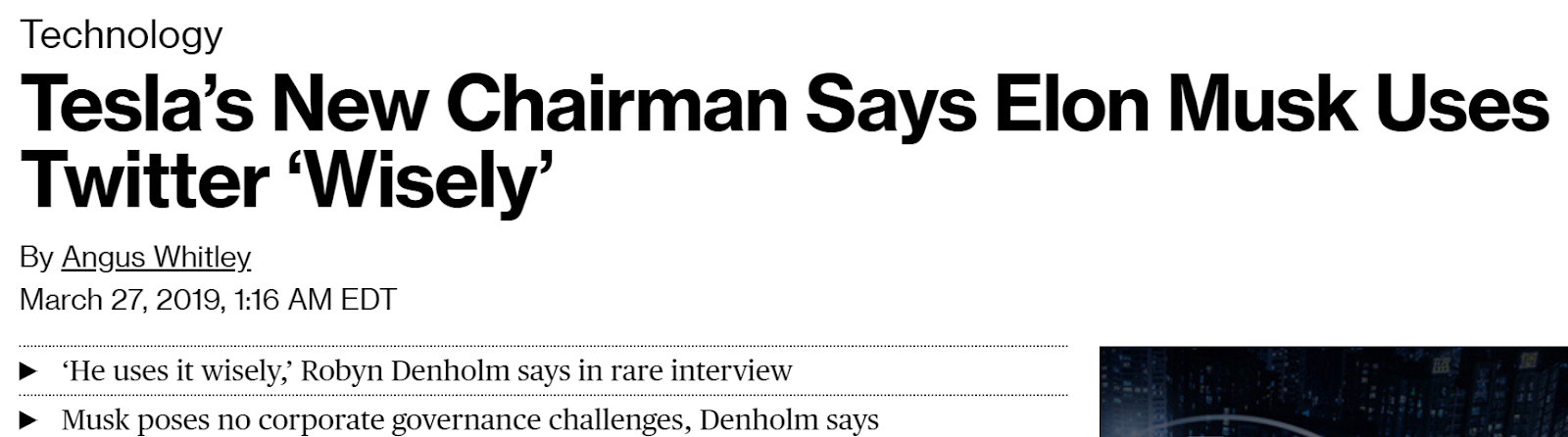
…and here"s what Musk gets for his shareholders" money from his new figurehead of an "independent" Chairwoman:
Musk"s public persona of impetuous stupidity as exemplified by his Twitter account undoubtedly provides an illuminating window into his private persona. Tesla has the most executive departures I"ve ever seen from any company (here"s the astounding full list), a dubious achievement that continued in March when in addition to the aforementioned departure of its chief engineer, still more folks departed from its already gutted finance department, as well as multiple other departments. This followed February"s departure of its general counsel after fewer than two months on the job, which followed January"s departure of its CFO, which followed the departures of a massive number of financial, manufacturing and engineering execs in 2018 and 2017. These people aren"t leaving because things are going great (or even passably) at Tesla; rather, they"re likely leaving because Musk is either an outright crook or the world"s biggest jerk to work for (or both). Could the business (if not the stock price) be saved in its present form if he left? Nope, it"s too late. Even if Musk steps down in favor of someone who knows what he"s doing, emerging competitive factors (outlined in great detail below) and Tesla"s balance sheet make the company too late to "fix" without major financial and operational restructuring.
Also in March, Navigant Consulting came out with its annual ranking of autonomous driving capabilities, and just as last year Tesla ranked dead last among active automakers and suppliers. Meanwhile, the number of lawsuits of all types against Tesla continues to escalate - there are now over 500!
How poorly is Tesla run? The quality of its products is one indication, and in February Consumer Reports published its annual auto reliability survey and guess who finished second-to-last? As one wag said on Twitter: you can now officially call Tesla "the Cadillac of electric cars":
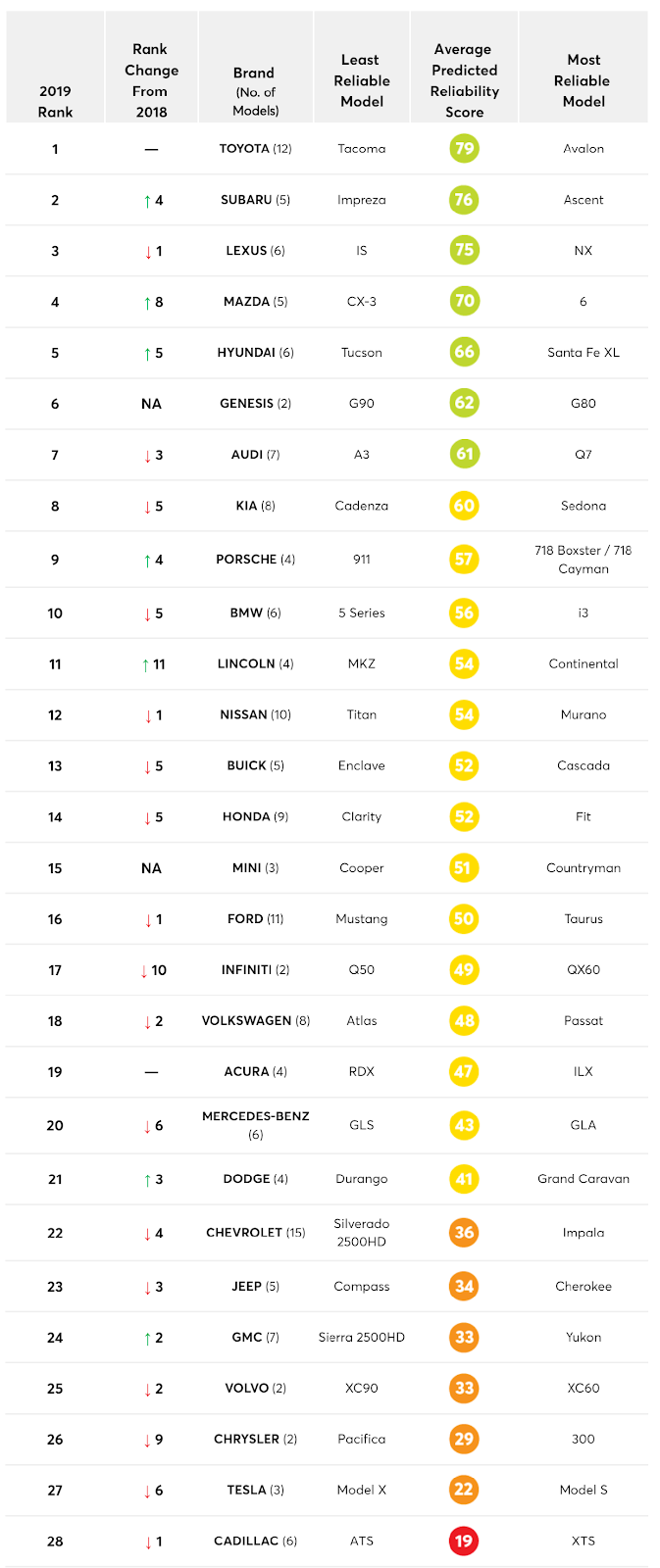
Consumer Reports" awful Tesla reliability data jibes with the latest survey from True Delta, which ranks Tesla last among all available vehicles, while in September, British magazine What Car? ranked Tesla reliability so low that it"s in "a league" of its own.
But what about all those Tesla owners who tell you how much they love their cars despite the service and reliability problems?
I"ve always argued that Tesla owners (and TSLA bulls) confuse "luxury electric car love" for "Tesla love," and now that superior European alternatives are beginning to roll out, Tesla drivers will flock to them. For instance, among those relatively near-term alternatives (out in late 2019) is the Porsche Taycan (OTCPK:POAHY) (here"s a great new video of it), and according to Porsche"s surveys, it"s Tesla drivers who are most interested in buying it. After its U.S. tax credit price advantage over Tesla (whose credits will be gone at the end of 2019), the stunning, Autobahn and Nürburgring-tested Taycan will cost roughly the same as the least expensive Tesla Model S and, among innumerable other advantages, will charge 2 ½ times as quickly and in the U.S. include three years of that charging as part of the purchase price. Hmm, Tesla or Porsche… Not a tough choice! Porsche has the capacity to build 40,000 Taycans a year, roughly the expected number of 2019 Model S sales before the Taycan steps in to steal pretty much all of them, and in March, Porsche announced that it already has over 20,000 orders. So Model S sales are about to be *so* dead. And if that"s not enough, a crossover version of the Taycan will follow soon thereafter, as will an all-electric version of the next Maycan. So Model X sales are *also* about to be *so* dead, especially in light of the other electric crossovers and SUVs discussed below…
Porsche"s offerings are just part of an onslaught of luxury EV competition that"s about to rip the face off sales of Tesla"s most profitable models, the S&X. The Audi (OTCPK:AUDVF) e-tron and Jaguar I-Pace (see below) are already crushing S&X sales in the European countries where they"re available, and the Audi arrives here in the U.S. in April. The e-tron is an all-electric SUV with a much nicer interior (and better build quality!) than any Tesla and a price that"s around $15,000 lower than the Model X before the Audi"s (initial) $3,750 to (eventual) $7,500 U.S. tax credit advantage. (Although the Audi"s range is expected to come in at around 225 miles vs. 295 miles for the Model X, the Audi will charge faster.) The e-tron received solid reviews (here, here, here and here), and three more electric Audis will follow it: the Sportback in late-2019 and, in 2020, the spectacular e-tron GT that recently debuted at the L.A. Auto show, as well as (in late 2020) the Q4 e-tron small electric crossover.
Also currently in showrooms is the Jaguar I-Pace (which received fabulous reviews, handily beating Tesla in comparison test after comparison test) and costing $20,000 less than the Model X and $15,000 less than the Model S, price gaps that widen by an additional $3,750 with Jaguar"s current U.S. tax credit advantage and escalate to $7,500 in January 2020. I"ve driven the Jaguar and can assure you that no objective person will say it isn"t much nicer than any Tesla.
The Mercedes EQC (OTCPK:DDAIF) (OTCPK:DMLRY) all-electric SUV will be widely available in Europe in the summer of 2019 and in the U.S. in early 2020, with an EPA range of around 225 miles and a price that will be nearly $30,000 (!) less than the Model X before the Mercedes" (by then) $7500 U.S. tax credit advantage. And by 2022 Mercedes will have ten fully electric models, covering nearly all its model lines.
And let"s not count out BMW (OTCPK:BMWYY); here"s a fascinating interview with its head EV powertrain engineer and a preview of its upcoming 2021 i4 and iX3.
Less expensive and available now are the excellent new all-electric Hyundai Kona (OTCPK:HYMLF) (OTCPK:HYMTF) and Kia Nero, extremely well reviewed small crossovers with an EPA range of 258 miles for the Hyundai and 238 miles for the Kia, at prices of under $30,000 inclusive of the $7,500 U.S. tax credit. I expect these cars to have an immediate and negative impact on sales of Tesla"s Model 3 and a future negative impact on Tesla"s Model Y (assuming, of course, the latter makes it to market before Tesla declares bankruptcy).
So here is Tesla"s competition in cars (note: these links are continually updated)…
THE NEW ALL-ELECTRIC JAGUAR I-PACE
2019 Jaguar XJ to be reborn as high-tech electric flagship
VW Group to launch 70 pure electric cars over the next decade
Audi e-tron electric SUV is available now
Audi e-tron Sportback comes late 2019
AUDI E-TRON GT FIRST DRIVE: LOOK OUT, TESLA (available 2020)
Audi"s Q4 e-tron previews entry-level EV for 2021
Porsche Electric Taycan Launches Late 2019
Porsche Taycan Cross Turismo to launch in 2020 after Taycan Sedan
The next generation of the Porsche Macan will be electric
New VW ID. hatch: order books for VW electric car open on May 2019
Mercedes EQC Electric SUV Available Mid-to-Late 2019
Mercedes to launch more than 10 all-electric models by 2022
258-Mile Hyundai Kona electric is available now for under $40,000
239-Mile Kia Niro EV is Available Now For Under $40,000
Kia Soul (available mid-2019) EV"s Range Jumps to 243 Miles
Kia Europe to have six pure electric models by 2022
Chevrolet Bolt Offers 238 Miles On A Single Charge
GM is transforming Cadillac into an electric brand
Nissan LEAF e+ with 226-mile range is available now
Nissan Leaf-based SUV coming in 2020
The 2020 Volvo Polestar 2 Is Priced to Beat Tesla"s Best-Selling Model 3
BMW iX3 electric crossover goes on sale in 2020
New BMW i4: Tesla-rivalling coupe seen winter testing
BMW to have 25 electrified models by 2025
Ford CEO says 16 electric models are in design & development
Peugeot 208 to electrify Europe"s small-car market
Toyota, Mazda, Denso create company to roll out electric cars beginning 2019
Toyota to market over 10 battery EV models in early 2020s
New Renault Zoe to feature 400km range
Renault aims to remain EV leader in Europe
Infiniti will go mostly electric by 2021
DS 3 Crossback will give PSA"s upscale brand an electric boost
ALL-ELECTRIC MINI COOPER COMING IN 2019
Smart Will Electrify Its Entire Line-up By 2020
SEAT will launch 6 electric and hybrid models and develop a new platform for electric vehicles
Opel/Vauxhall will launch electric SUV and van in 2020
2019 Skoda e-Citigo confirmed as brand"s first all-electric model
Skoda planning range of hot all-electric eRS models
New Citroen C4 Cactus to be first electrified Citroen in 2020
MG E-Motion confirms new EV sports car on the way by 2020
Fiat Chrysler bets on electrification for Alfa, Jeep and Maserati
Maserati offering three fully electric cars between 2020 and 2022
Rolls-Royce is preparing electric Phantom for 2022
Honda will offer full-EV or hybrid tech on every European model by 2025
Bentley mulls electric car to help reduce carbon footprint
Subaru to introduce all-electric vehicles by 2021
Korando will lead SsangYong"s push into electrification
Dyson Moves Ahead on $2.6 Billion Electric Car Plan
Lucid Motors closes $1 billion deal with Saudi Arabia to fund electric car production
Rivian (electric pick-up truck maker) Announces $700M Investment Round Led By Amazon
Borgward BXi7 Electric SUV Flies Under The Radar
Detroit Electric promises 3 cars in 3 years
SF Motors reveals two electric SUVs for 2019 with 300 miles of range
Two new electric cars from Mahindra in India by 2019; Global Tesla rival e-car soon
Saab asset owner NEVS plans electric car production
EV startup Canoo will only sell cars on a subscription basis
And in China…
VW, China spearhead $300 billion global drive to electrify cars
Audi Q2L e-tron debuts at Auto Shanghai
Audi China to roll out 12 locally-produced models in total by 2022
BYD launches EV535, all-electric SUV
BYD Song MAX BEV version with 500km range to hit market in 2019
2019 BYD Yuan EV360 goes on sale with prices starting RMB89,900 after subsidy
Daimler & BYD launch new DENZA electric vehicle for the Chinese market
BAIC and Daimler to Build $1.9 Billion China Plant
BAIC brings EX5 Electric SUV to market
BAIC BJEV, Magna ready to pour RMB2 bln in all-electric PV manufacturing JV
Daimler to Start EQC Electric SUV Production in China in 2019
GM China raises new-energy vehicle target to 20 models through 2023
Nissan & Dongfeng to invest $9.5 billion in China to boost electric vehicles
Toyota to Introduce 10 New Electrified Vehicles in China by 2020
Infiniti bringing EVs to China"s luxury car market
NIOS ES8 Electric Crossover debuts with half the Tesla Model X"s price tag
536 HP Nio ES6 Midsize Electric SUV Launches With 317-Mile Range at 1/2 the price of Tesla X
NIO"s third model said to be a sedan dubbed EP7
BMW will develop and produce electric Mini in China
Ford ramps up electric vehicle push in China
Jaguar Land Rover"s Chinese arm invests £800m in EV production
SAIC building factory in China for EVs from Roewe and MG
Renault and Brilliance Automotive to build 3 new electric light commercial vehicles for China
Honda launches new all-electric Everus VE-1 for ~$25,000 in China
Honda to roll out over 20 electric models in China by 2025
Geely all-new BEV sedan Jihe A starts at RMB150,000
Geely unveils GE11 compact BEV
New Geely Emgrand GSe crossover has EV range up to 400km
Changan building large scale NEV factory
Mazda and Changan Auto join hands on electric vehicles
XPENG Motors kicks-off sales of Tesla-infused EV for €30,000
XPENG Motors to unveil second model at Auto Shanghai 2019
WM Motors/Weltmeister EX5 Electric SUV Launched On The Chinese Car Market
Chery Breaks Ground on $240M EV Factory in China
Chery"s second EV plant open in Dezhou
BYTON to launch mass-produced M-Byte into market at the end of 2019
DearCC Launches ENOVATE Electric SUV
GAC NE to roll out 12 new models for Aion series, including solar-powered models
Guangzhou Auto To Launch Four New Electric Cars By 2020
Great Wall Launches New EV Brand (NYSE:ORA) In China
Singulato iS6 Electric SUV Debuts With 249-Mile Range
Singulato, BAIC partner to promote smart new energy vehicles
Hongqi launches E-HS3 BEV SUV with AWD option, 390km range and 0-100kh/h in 5.9 seconds
FAW (Hongqi) to roll out 15 electric models by 2025
JAC"s Electric Car Has A Range Of 500 Kilometers
ICONIQ to build electric cars in Zhaoqing with total investment of RMB 16 billion
Quianu Motor aims to grab share of US electric vehicle market
Hozon Kicks Off Mass Production With All-Electric Neta N01
Aiways U5 long-range electric SUV
All-electric NEVS 9-3 sedans (nee Saab) being built in China
Youxia Motors raises $1.25 billion to start 2019 EV production
CHJ Automotive buys Lifan for shortcut to EV production
Wanxiang Gets China Electric Vehicle Permit to Make Karma Cars
Qoros Auto"s new owner plans to be an EV power
JMC (Jianling Motor Corp.) Starts New EV Brand In China
Thunder Power Chinese EV manufacturer clinches deal with Belgian investment fund
Leapmotor raises RMB2.5 billion for Series A round to build electric cars
Continental, Didi sign deal on developing EVs for China
Here"s Tesla"s competition in autonomous driving…
Navigant Ranks Tesla Last Among Automakers & Suppliers for Automated Driving
What Smart Tesla fans Get Wrong about Full Self-Driving
Tesla has a self-driving strategy other companies abandoned years ago
Waymo Starts First Driverless Car Service
Jaguar and Waymo announce an electric, fully autonomous car
Waymo Expands Chrysler Self-Driving Fleet 100-Fold to 62,000
Nissan-Renault alliance to tie up with Waymo on self-driving cars
Uber, Waymo in talks about self-driving partnership
Lyft and Waymo Reach Deal to Collaborate on Self-Driving Cars
Cadillac Super Cruise Sets the Standard for Hands-Free Highway Driving
GM ride-hailing fleet would ditch steering wheel, pedals in 2019
Honda Joins with Cruise and General Motors to Build New Autonomous Vehicle
SoftBank Vision Fund to Invest $2.25 Billion in GM Cruise
Ford and VW Discuss Autonomous Car Team-Up at a $4 Billion Valuation
Volkswagen Group and Aurora Innovation Announce Strategic Collaboration On Self-Driving Cars
VW taps Baidu"s Apollo platform to develop self-driving cars in China
An Overview of Audi Piloted Driving
Daimler, BMW deepen cooperation with self-driving venture
Mercedes plans advanced self-driving tech for next S class
Bosch and Daimler join forces to market fully automated, driverless taxis by 2020
Daimler"s heavy trucks start self-driving some of the way
Volvo, Nvidia expand autonomous driving collaboration
Continental & NVIDIA Partner to Enable Production of Artificial Intelligence Self-Driving Cars
Intel"s Mobileye has 2 million cars (VW, BMW & Nissan) on roads building HD maps
Toyota"s moonshot: Self-driving car for sale - in 2020
Nissan and Mobileye to generate, share, and utilize vision data for crowdsourced mapping
Magna joins the BMW Group, Intel and Mobileye platform as an Integrator for AVs
Intel collaborates with Waymo on self-driving compute design
Fiat Chrysler to Join BMW, Intel and Mobileye in Developing Autonomous Driving Platform
Baidu, WM Motor announce strategic partnership for L3, L4 autonomous driving solutions
Baidu plans to mass produce Level 4 self-driving cars with BAIC by 2021
Volvo, Baidu to co-develop EVs with Level 4 autonomy for China
BYD partners with Huawei for autonomous driving
Lyft, Aptiv (formerly Delphi) partner on driverless ride-hailing at 2018 CES in Vegas
Lyft, Magna in Deal to Develop Hardware, Software for Self-Driving Cars
Hyundai, Aurora to release autonomous cars by 2021
Deutsche Post to Deploy Test Fleet Of Fully Autonomous Delivery Trucks This Year
Byton cooperating with Aurora on autonomous vehicles
ZF autonomous EV venture to start output this year, names first customer
Magna"s new MAX4 self-driving platform offers autonomy up to Level 4
Groupe PSA"s safe and intuitive autonomous car tested by the general public
Tencent, Changan Auto Announce Autonomous-Vehicle Joint Venture
Self-driving startup Momenta ready to launch fully automated driving solution in Q3 2019
JD.com Delivers on Self-Driving Electric Trucks
NAVYA Unveils First Fully Autonomous Taxi
Fujitsu and HERE to partner on advanced mobility services and autonomous driving
Lucid Chooses Mobileye as Partner for Autonomous Vehicle Technology
First Look Inside Zoox"s Autonomous Taxi
Nuro"s Robot Delivery Vans Are Arriving Before Self-Driving Cars
Here"s Tesla"s competition in car batteries…
LG Chem targets electric car battery sales of $6.3 billion in 2020
LG Chem to build $1.8 bln EV battery plant in China
Samsung SDI Unveils Innovative Battery Products at 2018 Detroit Motor Show
SK Innovation to boost EV battery production capacity more than tenfold by 2022
New Toshiba EV Battery Allows 320km Charge in 6 Minutes
Daimler starts building electric car batteries in Tuscaloosa - one of 8 battery factories
Panasonic Opens New Automotive Lithium-Ion Battery Factory in Dalian, China
Panasonic forms battery partnership with Toyota
CATL"s Chinese battery factory will be bigger than Tesla"s Gigafactory
CATL to set up battery cell manufacturing in Germany
BYD to quadruple car battery output with lithium site plants
GM inaugurates battery assembly plant in Shanghai
Volkswagen plans entry into battery cell production
VW Wants to One-Up Tesla With a Next-Generation Battery
Honda Partners on General Motors" Next Gen Battery Development
Energy Absolute Plots Asian Project Rivaling Musk"s Gigafactory
France"s Saft plans production of next-gen lithium ion batteries from 2020
Northvolt making ground on Gigafactory in Sweden
ABB teams up with Northvolt on Europe"s biggest battery plant
Chinese Battery Maker to Open Factory Next to Swedish EV Plant
Sokon aims to be global provider of battery, electric motor, electric control systems
BMW Group invests 200 million euros in Battery Cell Competence Centre
BMW Brilliance Automotive opens battery factory in Shenyang
BMW announces partnership with solid-state battery company
Toyota promises auto battery "game-changer"
VW increase stake in solid-state batteries with $100M investment
Hyundai Motor developing solid-state EV batteries
Wanxiang is playing to win, even if it takes generations
UK provides millions to help build more electric vehicle batteries
Rimac is going to mass produce batteries and electric motors for OEMs
Elon Musk Has A New Battery Rival (Romeo Power) Packed With His Ex-Employees
Evergrande acquires Cenat battery production
Bracing for EV shift, NGK Spark Plug ignites all solid-state battery quest
ProLogium Technology Will Produce First Next Generation Lithium Ceramic Battery For EVs
Here"s Tesla"s competition in storage batteries…
sonnenBatterie (acquired by Shell)
And here"s Tesla"s competition in charging networks…
EVgo Installing First 350 kW Ultra Fast Public Charging Station In The US
Tritium"s First 350-kW DC Fast Chargers Coming To U.S.
Porsche plans network of 500 fast chargers for U.S.
ChargePoint To Equip Mercedes Dealerships With 150kw Charging Stations For EQC
Recargo Ultrafast West Coast Charging
BMW, Daimler, Ford, VW, Audi & Porsche form IONITY European 350kw Charging Network
E.ON to have 10,000 150KW TO 350KW EV charging points across Europe by 2020
Europe"s Allego "Ultra E" ultra-fast charging network now operational
Allego & Fortum Launch MEGA-E High Power Charging network for Europe"s Metropolitan areas
ChargePoint Secures $240 Million in Additional Funding; $500 million raised in total
UK"s Podpoint installing 150kW EV rapid chargers this year; 350kW by 2020
UK National Grid plans 350kW EV charge point network
Fastned building 150kw-350kw chargers in Europe
Deutsche Telekom to build electric car charging network in Germany
ABB powers e-mobility with launch of first 150-350 kW high power charger
Shell buys European electric vehicle charging pioneer NewMotion
BP buys UK"s largest car charging firm Chargemaster
Total planning EV charging points at its French stations
VW Is Setting Up Electric Car Charging Stations in China
Yet, despite all that deep-pocketed competition, perhaps you want to buy shares of Tesla because you believe in its management team. Really???
Elon Musk Settles SEC Fraud Charges
Elon Musk, June 2009: "Tesla will cross over into profitability next month"
Tesla SEC Correspondence Shows A Pattern Of Inaccurate, Incomplete & Misleading Disclosures
Tesla: Check Your Full Self-Driving Snake Oil Expiration Date
As Musk Hyped and Happy-Talked Investors, Tesla Kept Quiet About a Year-Long SEC Probe
The Truth Is Catching Up With Tesla
With Misleading Messages And Customer NDAs, Tesla Performs Stealth Recall
Who You Gonna Believe? Elon Musk"s Words Or Your Own Lying Eyes?
How Tesla and Elon Musk Exaggerated Safety Claims About Autopilot and Cars
When Is Enough Enough With Elon Musk?
Musk Talked Merger With SolarCity CEO Before Tesla Stock Sale
Tesla Continues To Mislead Consumers
Tesla Misses The Point With Fortune Autopilot Story
Tesla Timeline Shows Musk"s Morality Is Highly Convenient
Tesla Scares Customers With Worthless NDAs, The Daily Kanban Talks To Lawyers
Tesla: Contrary To The Official Story, Elon Musk Is Selling To Keep Cash
Tesla: O, What A Tangled Web We Weave When First We Practice To Deceive
I Put 20 Refundable Deposits On The Tesla Model 3
Tesla: A Failure To Communicate
Elon Musk Appears To Have Misled Investors On Tesla"s Most Recent Conference Call
Understanding Tesla"s Potemkin Swap Station
Tesla"s Amazing Powerwall Reservations
So in summary, Tesla is losing a massive amount of money even before it faces a huge onslaught of competition (and things will only get worse once it does), while its market cap tops that of Ford (NYSE:F) and nearly matches General Motors" (NYSE:GM) despite selling approximately 300,000 cars a year while Ford and GM make billions of dollars selling 6 million and 8.4 million vehicles, respectively. Thus, this cash-burning Musk vanity project is worth vastly less than its roughly $60 billion enterprise value and-thanks to roughly $34 billion in debt, purchase and lease obligations - may eventually be worth "zero."
Elsewhere among our short positions…
We continue (since late 2012) to hold a short position in the Japanese yen via the Proshares UltraShort Yen ETF (NYSEARCA:YCS) as Japan continues to print nearly 5% of its monetary base per year after nearly quadrupling that base since early 2013. In fact, of the world"s three largest central banks (the Fed, ECB and BOJ), the BOJ is now the only one still conducting QE, and in February, it reiterated its intent to continue doing so. One result of this insane policy (in 2018, the BOJ bought approximately 67% of JGB issuance and in 2019 anticipates buying 70%!) is there are days when no 10-year JGBs trade in the cash market! The BOJ"s balance sheet is now larger than the entire Japanese economy - it owns approximately 43% of all government debt…
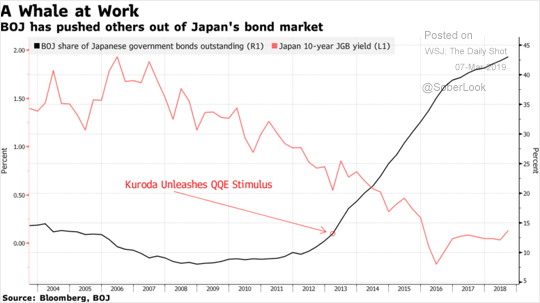
…and over 75% (!) of the country"s ETFs by market value.
Just the interest on Japan"s debt consumes 8.9% of its 2019 budget despite the fact that it pays a blended rate of less than 1%. What happens when Japan gets the 2% inflation it"s looking for and those rates average, say, 3%? Interest on the debt alone would consume nearly 27% of the budget and Japan would have to default! But on the way to that 3% rate the BOJ will try to cap those rates by printing increasingly larger amounts of money to buy more of that debt, thereby sending the yen into its death spiral.
When we first entered this position, USD/JPY was around 79; it"s currently in the 110s, and long term, I think it"s headed a lot higher - ultimately back to the 250s of the 1980s or perhaps even the 300s of the "70s before a default and reset occur.
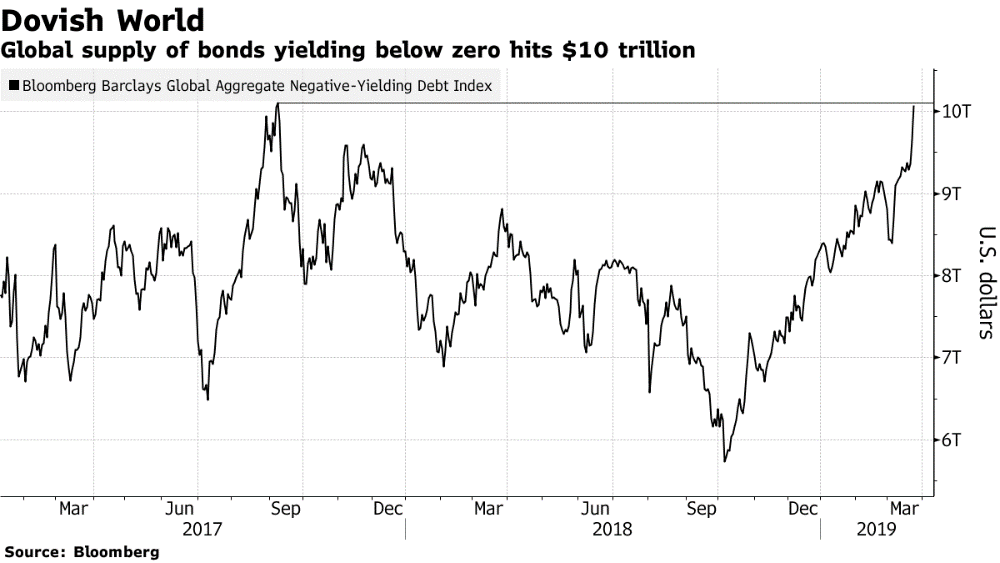
We continue to hold a short position in the Vanguard Total International Bond ETF (NASDAQ:BNDX), comprised of dollar-hedged non-US investment grade debt (over 80% government) with a ridiculously low "SEC yield" of 0.81% at an average effective maturity of 9.4 years. As I"ve written since putting on this position in July 2016, I believe this ETF is a great way to short what may be the biggest asset bubble in history, as with Eurozone inflation now printing 1.5% annually, these are long-term bonds with significantly negative real yields. In mid-December, the ECB halted quantitative easing, thereby removing the biggest source of support for those bonds" bubble prices. Currently, the net borrow cost for BNDX provides us with a positive rebate of over 1.7% a year (more than covering the yield we pay out), and as I see around 5% potential downside to this position (vs. our basis, plus the cost of carry) vs. at least 20% (unlevered) upside, I think it"s a terrific place to sit and wait for the inevitable denouement of this insanity:
And now for the fund"s long positions…
We continue to own Westell Technologies Inc. (NASDAQ:WSTL), a 43% gross margin telecom equipment maker (of primarily small-cell repeaters) in turnaround mode. In February, Westell reported a mediocre FY 2019 third quarter, with revenue down 22% year-over-year but up 6% sequentially, and although it burned around $970,000 in free cash flow, it ended the quarter with $27.1 million in cash ($1.75/share) and no debt, and on the follow-up conference call, management explicitly indicated that it expects to return to break-even or better within a year. Westell sells at an enterprise value of only around 0.10x (i.e. 10% of) revenue, but in addition to the (hopefully soon-to-reverse) cash burn, the "hair" on this company is the long-term decline in revenue (which now appears to have stabilized and should soon reverse), a cash pile that could potentially be squandered on dumb acquisitions (a risk with all cash-rich companies) and - perhaps most annoyingly - a dual share class, with voting control held by descendants of the founder. However, on the conference call, management claimed the controlling family is open to merging the two share classes, and Westell is so cheap on an EV-to-revenue basis that if management can"t start generating meaningful profits, it seems primed for a strategic buyer to acquire it. An acquisition price of 1x run-rate revenue (on an EV basis) would be around $4.50/share.
We continue to own Aviat Networks, Inc. (NASDAQ:AVNW), a designer and manufacturer of point-to-point microwave systems for telecom companies, which in February reported a decent Q2 for FY 2019, with revenue up 2% year-over-year (adjusted for a GAAP-mandated change in revenue recognition to ASC 606; unadjusted revenue was up 5.5%). For FY 2019, the company guided to $250-$255 million of revenue and non-GAAP EBITDA of $12.5-$13 million, and because of its approximately $330 million of U.S. NOLs, $10 million of U.S. tax credit carryforwards, $214 million in foreign NOLs and $2 million of foreign tax credit carryforwards, Aviat"s income will be tax-free for many years; thus, GAAP EBITDA less capex essentially equals "earnings." So if the non-GAAP number will be $12.5 million and we take out $1.7 million in stock comp and $6 million in capex, we get $4.8 million in earnings multiplied by, say, 16 = approximately $77 million; if we then add in at least $30 million of expected year-end net cash and divide by 5.4 million shares, we get an earning-based valuation of around $20/share. However, the real play here is as a buyout candidate; Aviat"s closest pure-play competitor, Ceragon (NASDAQ:CRNT) sells at an EV of approximately 0.7x revenue, which for AVNW (based on the mid-point of 2019 guidance) would be around $207 million. If we value Aviat"s massive NOLs at a modest $10 million (due to change-in-control diminution in their value), the company would be worth $217 million divided by 5.4 million shares = $40/share.
We continue to own the Invesco DB Agriculture ETF (NYSEARCA:DBA), which I first bought in late 2017 because agricultural products were the most beaten-down sector I could find that wasn"t a "buggy whip" (something on the way to obsolescence) or cyclical from a demand standpoint. The "DBIQ Diversified Agriculture Index" on which DBA is based is at its lowest level since 2002, and I continue to anticipate a major bounce following a favorable outcome from U.S.-China trade talks. Trump is very conscious of the fact that farm states constitute a significant part of his political base and the China deal implications for U.S. ag products would be huge. Meanwhile, extensive midwestern U.S. flooding (a real tragedy for those affected) put a bit of a tailwind behind this ETF in mid-March (although it subsequently surrendered some of those gains).
Thanks and regards,
Mark Spiegel
Editor"s Note: The summary bullets for this article were chosen by Seeking Alpha editors.
Subscribe to:
Comments (Atom)